Training Management Best Practices for Growing Institutions
Managing modern training delivery requires aligning curriculum planning, faculty allocation, learner tracking, and billing. Explore proven operational best practices for scaling training organizations.
- 1. The Shift to Unified Training Operations
- 2. Standardizing Course & Batch Hierarchies
- 3. Optimizing Faculty Allocation & Conflict Prevention
- 4. Unifying Admissions with Enrollment Timetables
- 5. Continuous Operational Auditing & Matrix Analytics
- 6. Summary & Transformation Roadmap
- • Key Takeaways
Need a custom training operations platform?
Get Custom Pricing1. The Shift to Unified Training Operations
Growing training institutions face exponential operational complexity as course offerings, faculty numbers, and student enrollments increase. Relying on disconnected point solutions for CRM, timetables, and billing leads to data silos and administrative friction.
Adopting unified training operations connects every department—from marketing counselors to academic coordinators and finance accountants—onto a shared operational database.
2. Standardizing Course & Batch Hierarchies
Establish standardized academic architectures: Course → Subject → Module → Unit hierarchies with predefined lecture hours, lab requirements, and grading criteria. Standardizing curricula enables multi-branch training networks to deliver consistent quality across all locations.
3. Optimizing Faculty Allocation & Conflict Prevention
Prevent trainer burnout and double-booking with visual scheduling calendars. Systems should automatically detect instructor availability conflicts, calculate weekly teaching hours against contract maximums, and accommodate institutional holiday calendars.
4. Unifying Admissions with Enrollment Timetables
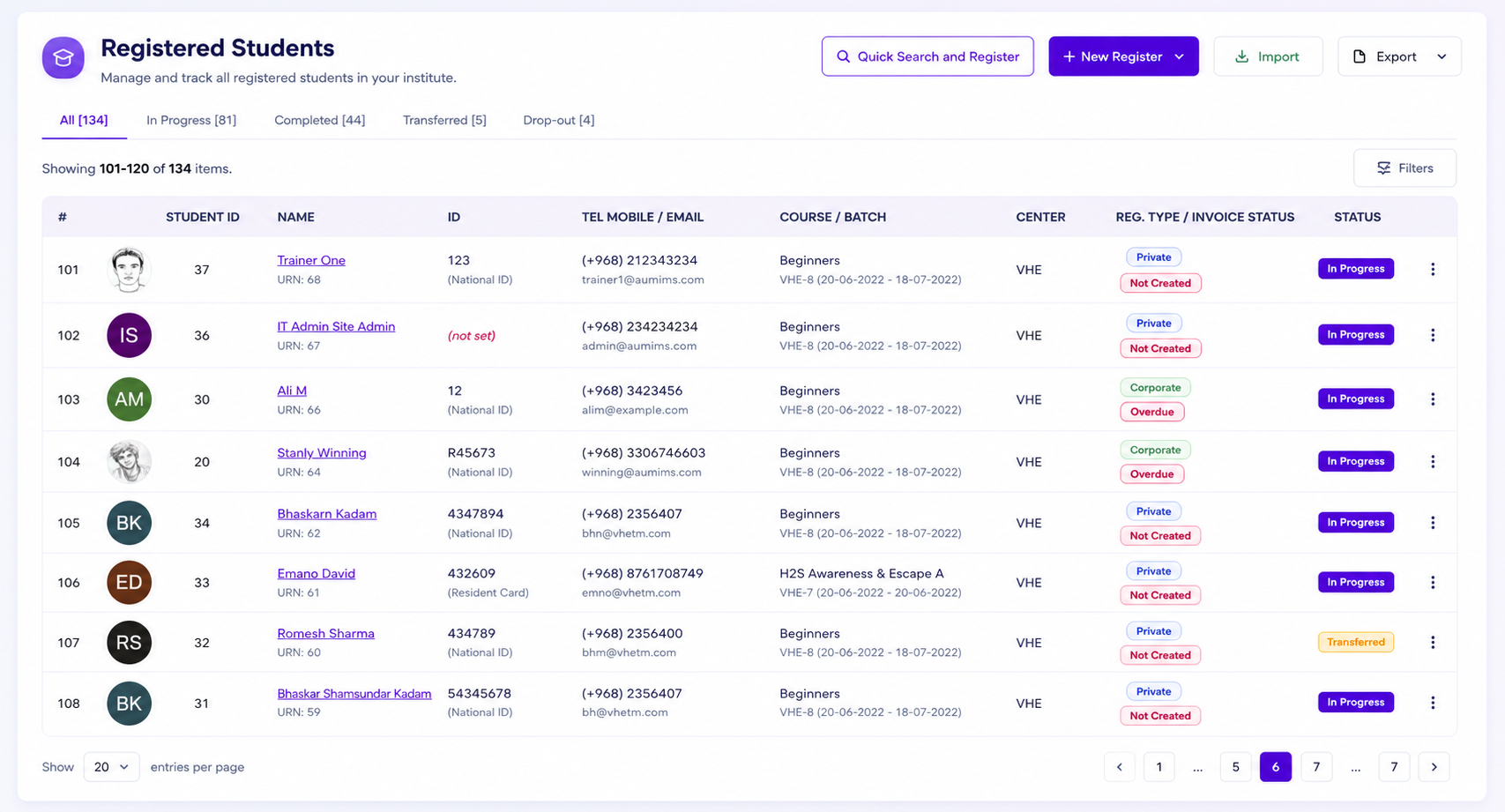
When a counselor qualifies an inquiry, the student should convert into an enrolled batch participant with one click. This conversion must automatically generate installment fee milestones and assign the trainee to the visual batch schedule without manual data re-entry.
5. Continuous Operational Auditing & Matrix Analytics
Review weekly performance matrices: track batch fill rates against break-even targets, monitor faculty utilization, and audit uncollected fee installment velocity across all branch centers.
6. Summary & Transformation Roadmap
Standardizing processes and unifying operational data allows training providers to scale enrollment volume without proportionally increasing administrative overhead.
Key Takeaways
- Establish an integrated single source of truth across admissions, scheduling, and accounting.
- Standardize curriculum hierarchies and batch naming conventions across all campuses.
- Automate timetable conflict detection to prevent instructor over-allocation.
- Connect admissions CRM directly with installment fee ledgers to eliminate revenue leakage.
VheTM Training Management Engine
Manage courses, multi-session batches, faculty allocations, and student intake from one central operations platform.
Explore Training ManagementReady to Improve Your Training Operations?
Explore how VheTM helps training institutes, colleges, universities, and corporate L&D teams manage courses, learners, attendance, assessments, certifications, reporting, and communication in one unified platform.