Training Operations Guide
An end-to-end operational guide for training directors, operations managers, and academic coordinators seeking to streamline delivery, eliminate administrative bottlenecks, and scale training capacity.
- 1. What Are Training Operations?
- 2. The 10 Pillars of Modern Training Operations
- 3. Common Operational Bottlenecks & Failure Points
- 4. How to Reduce Manual Administration
- 5. Improving Training Visibility & Faculty Utilization
- 6. Standardizing Multi-Center & Branch Workflows
- 7. Leveraging Technology for Operational Excellence
- 8. Training Operations Health Audit Checklist
- 9. Summary & Operational Transformation
- • Key Takeaways
Need a custom training operations solution?
Get Custom Pricing- 1. What Are Training Operations?
- 2. The 10 Pillars of Modern Training Operations
- 3. Common Operational Bottlenecks & Failure Points
- 4. How to Reduce Manual Administration
- 5. Improving Training Visibility & Faculty Utilization
- 6. Standardizing Multi-Center & Branch Workflows
- 7. Leveraging Technology for Operational Excellence
- 8. Training Operations Health Audit Checklist
- 9. Summary & Operational Transformation
1. What Are Training Operations?
Training Operations encompasses the end-to-end administrative, logistical, pedagogical, and financial processes required to deliver education and skills development programs at scale. While instructors focus on teaching and students focus on learning, operations teams orchestrate the complex infrastructure that makes learning possible—including admissions pipelines, classroom allocation, attendance enforcement, examination rubrics, certification attestation, and financial billing.
2. The 10 Pillars of Modern Training Operations
High-performing training institutions manage their operations across 10 interconnected operational pillars:
1. Curriculum & Syllabus Structuring
Course → Subject → Module → Unit hierarchies with defined hourly lecture distributions.
2. Admissions & Enrollment Pipelines
Lead intake, counselor allocations, automated follow-up tasks, and student record creation.
3. Batch Timetable Scheduling
Classroom booking, holiday calendar sync, trainer availability checks, and recurring timetables.
4. Attendance Compliance & Gating
Session-level digital attendance logging, deficit escalation warnings, and exam qualification gating.
5. Examination & Rubric Scoring
Theory, practical, viva, and subjective scoring rubrics with automated transcript generation.
6. Serialized QR Certification
Multi-tier sign-off approval pipelines and instant public scannable QR verification.
7. Financial Ledgers & Fee Installments
Category fee heads, milestone installment plans, counter receipts, and GST ledgers.
8. Multi-Agent Student Messaging
Shared WhatsApp desks, automated schedule notices, and payment due alerts.
9. Multi-Campus Network Governance
Isolated branch centers, localized staff permissions, and consolidated group rollups.
10. Matrix Analytics & Forecasting
Trainer workload utilization, center revenue performance, and sales target gap tracking.
3. Common Operational Bottlenecks & Failure Points
Operational failure in training institutes typically arises from isolated department silos:
- Counselor & Finance Disconnect: Counselors promise custom installment plans without automated fee schedule generation, leading to delayed payments.
- Faculty Over-Allocation: Instructors are booked across overlapping batches without automated conflict alerts, harming teaching quality.
- Certification Backlogs: Issuing paper certificates manually creates weeks of delays after batch graduation.
- Inaccurate Performance Reporting: Executive leadership lacks real-time visibility into branch-level trainer utilization and lead conversion rates.
4. How to Reduce Manual Administration
Modern training organizations eliminate administrative overhead through automated operational triggers:
- Automated Batch Enrollment: Converting a qualified CRM lead into an enrolled trainee generates their installment fee schedule and assigns them to the batch timetable automatically.
- Automated Absence Alerts: Marking a student absent in a digital register triggers an instant WhatsApp notification to the student or parent.
- Threshold-Gated Credentials: When a student satisfies minimum attendance and assessment criteria, their certificate moves into the registrar approval queue automatically.
5. Improving Training Visibility & Faculty Utilization
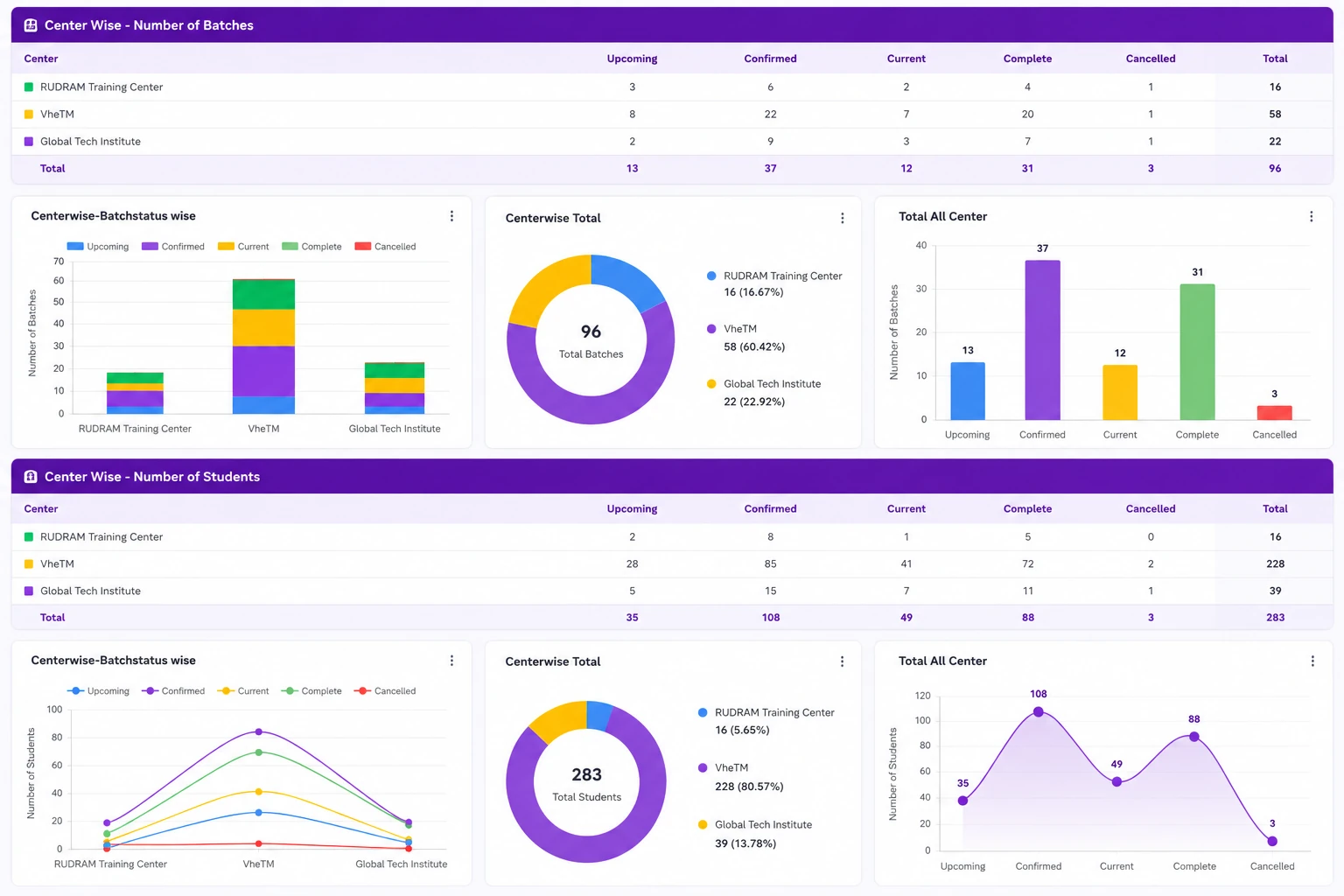
Maximizing training profitability requires deep operational analytics. Key metrics to track weekly include:
Faculty Utilization
Track active teaching hours per trainer vs. contracted capacity.
Room Seating Occupancy
Identify underutilized physical classrooms and lab slots.
Fee Collection Velocity
Monitor committed vs. collected installment milestones in real time.
6. Standardizing Multi-Center & Branch Workflows
When operating across multiple branch campuses, operational consistency is paramount. Standardize central curriculum hierarchies, examination rubrics, and fee structures while granting branch coordinators the flexibility to schedule localized batches and assign branch instructors.
7. Leveraging Technology for Operational Excellence
Transitioning from disconnected point solutions to an integrated Training Operations ERP like VheTM unites marketing, administration, academics, and finance on a single shared database—eliminating manual data entry errors and accelerating institutional scale.
8. Training Operations Health Audit Checklist
Audit your training operations with this 8-point operational health checklist:
| # | Operational Benchmark | Status |
|---|---|---|
| 1 | Are course batches scheduled on a central visual calendar with clash detection? | Standard with VheTM |
| 2 | Is session attendance logged digitally with automated percentage deficit alerts? | Standard with VheTM |
| 3 | Are student fee installments tracked against automated double-entry ledgers? | Standard with VheTM |
| 4 | Are certificates generated with unique serials and public scannable QR codes? | Standard with VheTM |
| 5 | Is student communication managed through a shared multi-agent WhatsApp desk? | Standard with VheTM |
| 6 | Are branch permissions isolated while providing consolidated group analytics? | Standard with VheTM |
| 7 | Do leadership dashboards display real-time trainer utilization and revenue? | Standard with VheTM |
| 8 | Can compliance and audit records be exported in one click for regulators? | Standard with VheTM |
9. Summary & Operational Transformation
Streamlining training operations is the fastest way to increase institutional profitability, improve student satisfaction, and scale training capacity without adding administrative staff. Explore how VheTM provides the operational engine for leading training organizations.
Key Takeaways
- Establish an integrated single source of truth across admissions, scheduling, and accounting.
- Automate repetitive administrative workflows like absence notices and installment billing.
- Enforce strict attendance percentage thresholds to safeguard regulatory compliance.
- Track instructor utilization and classroom occupancy to maximize capacity profitability.
- Standardize multi-branch processes with isolated center permissions and group rollups.
VheTM 9 Core Features Suite
Discover how VheTM brings training management, scheduling, attendance, assessments, QR certification, accounting, and messaging into one connected platform.
Explore All 9 Core FeaturesReady to Improve Your Training Operations?
Explore how VheTM helps training institutes, colleges, universities, and corporate L&D teams manage courses, learners, attendance, assessments, certifications, reporting, and communication in one unified platform.