How to Improve Training Attendance: Practical Strategies for Training Providers
Poor attendance disrupts batch pacing, increases dropout rates, and jeopardizes regulatory accreditation. Discover practical operational strategies and automated workflows to maintain high attendance rates.
- 1. Why Attendance Is the Foundation of Training Success
- 2. Common Causes of Attendance Leakage
- 3. Strategy 1: Multi-Channel Pre-Session Reminders
- 4. Strategy 2: Real-Time Digital Attendance Registers
- 5. Strategy 3: Automated Absence Escalations
- 6. Strategy 4: Enforcing Attendance Percentage Gating
- 7. Summary & Actionable Attendance Checklist
- • Key Takeaways
Need a custom training operations platform?
Get Custom Pricing- 1. Why Attendance Is the Foundation of Training Success
- 2. Common Causes of Attendance Leakage
- 3. Strategy 1: Multi-Channel Pre-Session Reminders
- 4. Strategy 2: Real-Time Digital Attendance Registers
- 5. Strategy 3: Automated Absence Escalations
- 6. Strategy 4: Enforcing Attendance Percentage Gating
- 7. Summary & Actionable Attendance Checklist
1. Why Attendance Is the Foundation of Training Success
In instructor-led, blended, and vocational training, consistent learner attendance is the primary predictor of successful course completion and skill mastery. When learners miss sessions, instructor pacing slows down, peer group dynamics degrade, and certification qualifications are compromised.
For regulated training academies and corporate L&D teams, attendance records are also legal compliance artifacts. Accrediting bodies and corporate sponsors require auditable proof that trainees satisfied mandatory contact hour quotas before awarding official credentials.
2. Common Causes of Attendance Leakage
Attendance drops rarely happen without operational warning signs. The most frequent causes include:
- Lack of Timely Pre-Session Notifications: Learners forget timetable changes or upcoming session slots when notifications rely solely on buried emails.
- Delayed Absence Visibility: When instructors use paper sign-in sheets, coordinators only discover chronic absenteeism days or weeks later when intervention is too late.
- Friction in Timetable Rescheduling: Inflexible batch scheduling makes it difficult for working professionals to attend makeup sessions.
- Absence of Clear Consequences: When minimum attendance percentages are not strictly enforced, learners treat live sessions as optional.
3. Strategy 1: Multi-Channel Pre-Session Reminders
The simplest way to reduce accidental absenteeism is automating pre-session alerts. Modern training operations trigger automated WhatsApp and SMS notices 24 hours and 1 hour before scheduled class times, including the session topic, instructor name, and physical room or live link.
Because WhatsApp open rates exceed 90%, direct messaging dramatically outperforms traditional email alerts for busy trainees.
4. Strategy 2: Real-Time Digital Attendance Registers
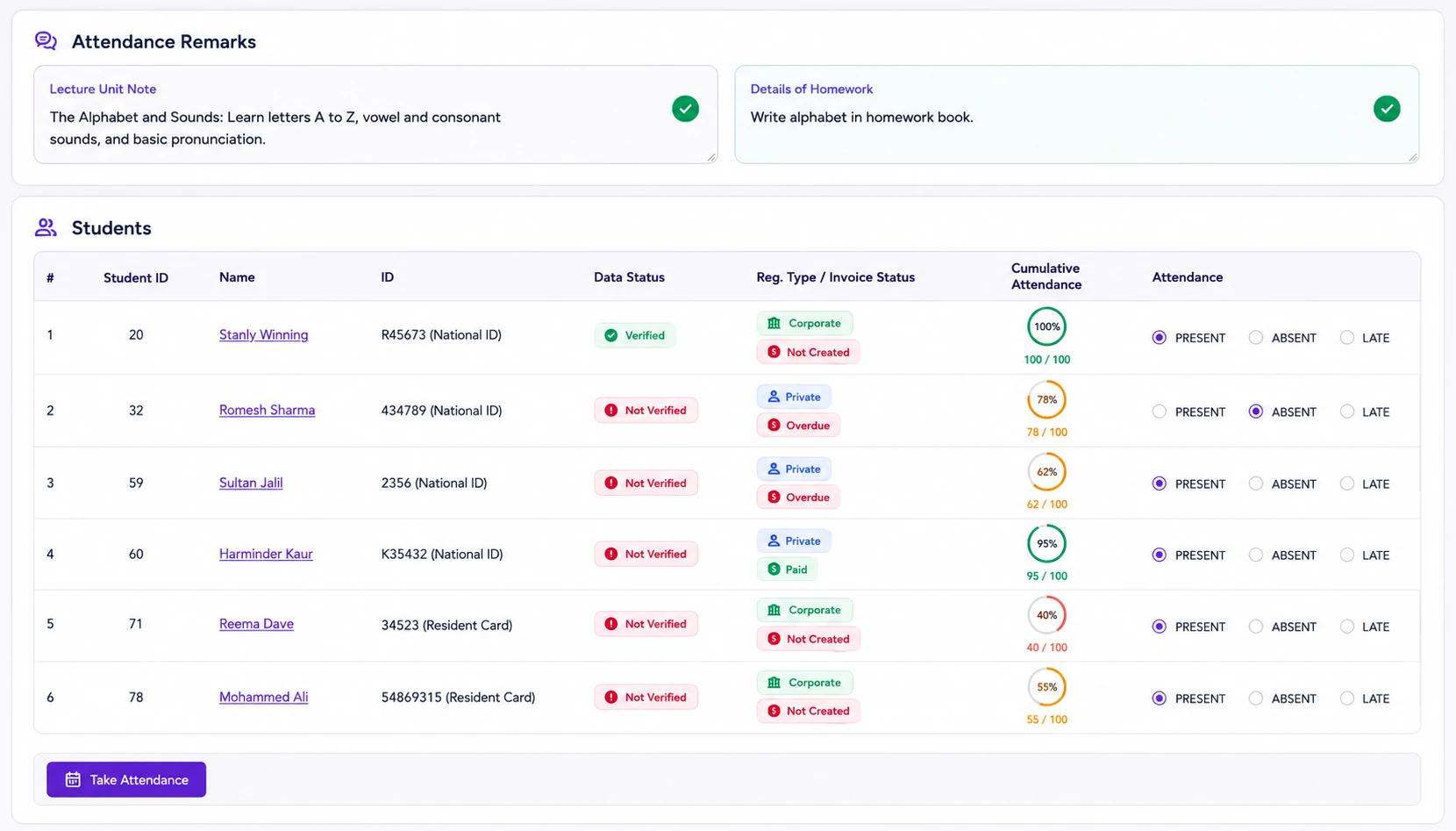
Replace paper sign-in sheets and manual spreadsheet tallying with mobile-friendly digital attendance registers. Instructors log presence, tardiness, or excused absences directly within the system in under 30 seconds per session.
Digital registers update the student's aggregate attendance percentage instantly, giving academic coordinators immediate operational visibility across all active batches.
5. Strategy 3: Automated Absence Escalations
When an instructor marks a trainee absent, the system should trigger an immediate, automated alert to the learner (and their corporate sponsor or guardian) acknowledging the missed session and providing a summary of the covered lecture notes.
Immediate follow-up signals institutional rigor and allows counselors to intervene before minor absences turn into full cohort dropouts.
6. Strategy 4: Enforcing Attendance Percentage Gating
Establish a transparent institutional rule: trainees who fail to satisfy a minimum attendance threshold (e.g. 75% or 80% of total contact hours) are automatically blocked from registering for final examinations or receiving certificates until makeup hours are completed.
Automating this gating rule removes subjective instructor discretion and guarantees strict compliance across all campus locations.
7. Summary & Actionable Attendance Checklist
Improving attendance requires combining automated communication with digital logging and transparent policy enforcement. By replacing paper sheets with integrated digital registers, institutions protect accreditation and ensure high graduation rates.
Key Takeaways
- Replace paper sign-in sheets with real-time digital session logging.
- Send automated pre-session WhatsApp notifications 24 hours and 1 hour prior to class.
- Trigger instant absence alerts to learners and corporate sponsors upon missed sessions.
- Enforce automated attendance percentage threshold gating before permitting examination attempts.
VheTM Attendance & Training Delivery Engine
Automate daily batch attendance registers, calculate percentage compliance in real time, and gate final exam eligibility.
Explore Attendance FeaturesReady to Improve Your Training Operations?
Explore how VheTM helps training institutes, colleges, universities, and corporate L&D teams manage courses, learners, attendance, assessments, certifications, reporting, and communication in one unified platform.